
The environment that rural providers work in is very different than those in suburban or urban areas. Rural communities most frequently need assistance with strategically planning for responses to community needs, resource allocations, and establishing community support for new programs and activities. Traditional funding opportunities often do not provide funding for these sorts of activities and providers don’t have discretionary funding that could be used to purchase these services.
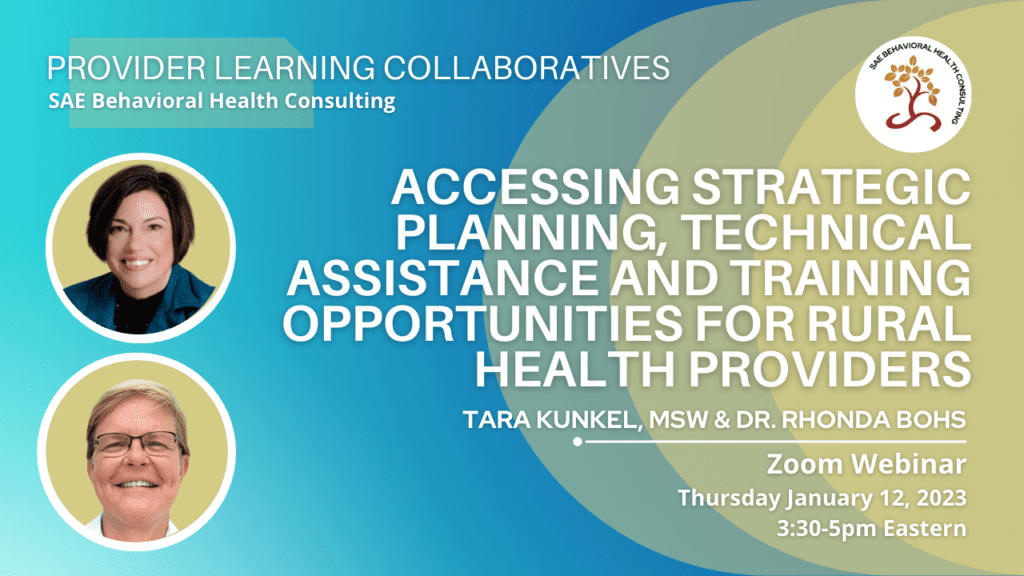
In this Provider Learning Collaborative, SAE experts Tara Kunkel, MSW, and Dr. Rhonda Bohs discuss ways in which Rural Providers can access training and technical assistance funding to facilitate agency and community planning, and how to access national resources to support agency efforts.
The focus of this PLC is on the types and kinds of training and technical assistance resources that are available to rural providers, best access to these resources, and a developmental strategy to facilitate the implementation of new programs and activities, beginning with strategic planning.
Learning Objectives:
Identifying resources and funding to support technical assistance and training needs
Learning how a strategic planning process can facilitate agency development and sustainability
How to develop multisystem community collaborations (i.e., behavioral health, primary health, court programs, first responders, schools)
Barriers that rural communities face in the implementation of programs and ways to navigate around them.
Click to access the recording.
BIOS
Rhonda Bohs, Ph.D., has over 25 years of experience in conducting research and program evaluation including serving as the lead evaluator for multiple SAMHSA-funded initiatives. Additionally, Dr. Bohs has served as Site Investigator for activities in the NIDA Clinical Trials Network and as Co-Principal Investigator on a P20 Research Center grant in collaboration with Florida International University and funded through the National Center on Minority Health Disparities.
Dr. Bohs received her M.S. degree in Research and Ph.D. in Applied Experimental Psychology with an emphasis in Social Psychology from Saint Louis University. She has conducted research and program evaluation in health disparities, as well as program evaluation in hospital, community mental health centers, health departments, community based organizations and business settings. Throughout her career, Dr. Bohs has developed an expertise in implementing and evaluating programs targeting special populations, hard‑to‑reach populations, and in developing and implementing systems of care strategies within community based organizations and integrating behavioral and primary health service delivery systems.
Dr. Bohs is also SAE’s Director of Operations.
Tara Kunkel, MSW, is an award-winning, nationally known expert in the fields of criminal justice, substance use disorders, law enforcement, and public health and the way they intersect at both the national and community levels.
Currently, Tara is working on three wide-ranging national initiatives. The Rural Justice Collaborative centers on improving justice inequalities in rural communities, by creating a new model centered on rural leaders developing solutions to rural problems, which can be replicated. A second project, funded by the U.S. Department of Justice, National Institute of Corrections, deals with the effects of extreme stress and “vicarious trauma” and how it directly impacts parole and probation officers. And a third project, the Adoption of Virtual Services in Judicially Led Diversion Programs Initiative, is examining how the COVID-19 pandemic has affected the court system and their justice and treatment partners, as they were forced to operate online.
She has also served as a Senior Drug Policy Advisor at the U.S. Department of Justice, Bureau of Justice Assistance and led the implementation of the Comprehensive Opioid Abuse Program and grew it from a $27 million grant program in 2017 to $187 million in 2019.
As an independent consultant, Kunkel has directed over 25 projects within the criminal justice system for various cities, counties and states, as well as overseas.